Acoustic Ground Hum Elimination
Acoustic Ground Hum Elimination Hydrophones have been used for the recording
and documentation of ocean events for many years. However there is an inherent
problem whether you are recording on a boat or monitoring from a land based
research site - ground hum. This project developed a unique technique that
eliminates ground hum on land and proposes a similar applied technique for
recording while on a boat. Read more...
Castaway & Calf Project
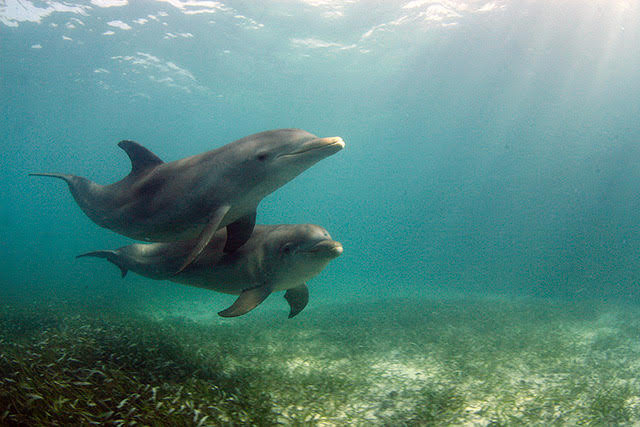
A study of the acoustic characteristics of underwater sounds produced by
a single male neonatal wild offshore bottlenose dolphin (Tursiops truncatus)
named Wilson in Key Largo, Florida. Wilson was born at Marine Mammal Conservancy,
where his mother, Castaway, was in rehab after stranding repeatedly on the
Florida Coast. We recorded complex whistles and also burst-pulses sounds emitted
by Wilson only seconds after birth. In addition, we recorded Wilson using

echolocation while still emerging from the womb. (He was born breech-head first.

Dolphins are normally born tail first.) Although Wilson lived only four days, the
uniquely isolated situation of his birth gave us a rare chance to record neonate
sounds, providing a great deal of acoustic data for detailed analysis.
Our study of Wilson's vocalizations and echolocation has three main goals (1)
defining the structural and functional characteristics of this infants' call and
comparing them to adult data, (2) determining if playing recorded dolphins sounds
as acoustic enrichment of Wilson's and Castaway's water environment, while Wilson
was still in utero, had an effect on Wilson's sound production after birth and (3)
standardizing infant call terminology. This project is the most comprehensive acoustic
recording project ever attempted in high definition underwater sound. This data is now
being analyzed at the University of Southern Mississippi, under the direction of Dr. Stan
Kuczaj. Results of this research will be available soon. Read
more...
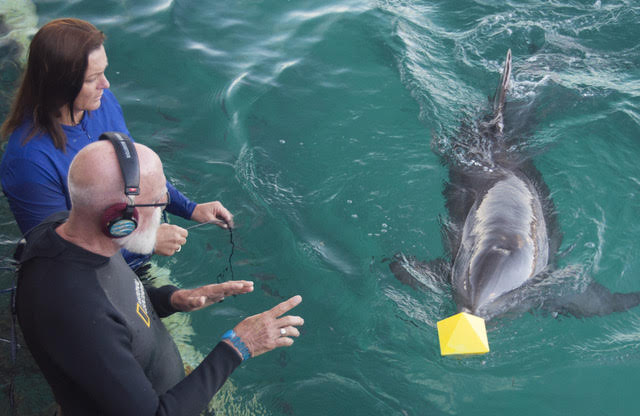
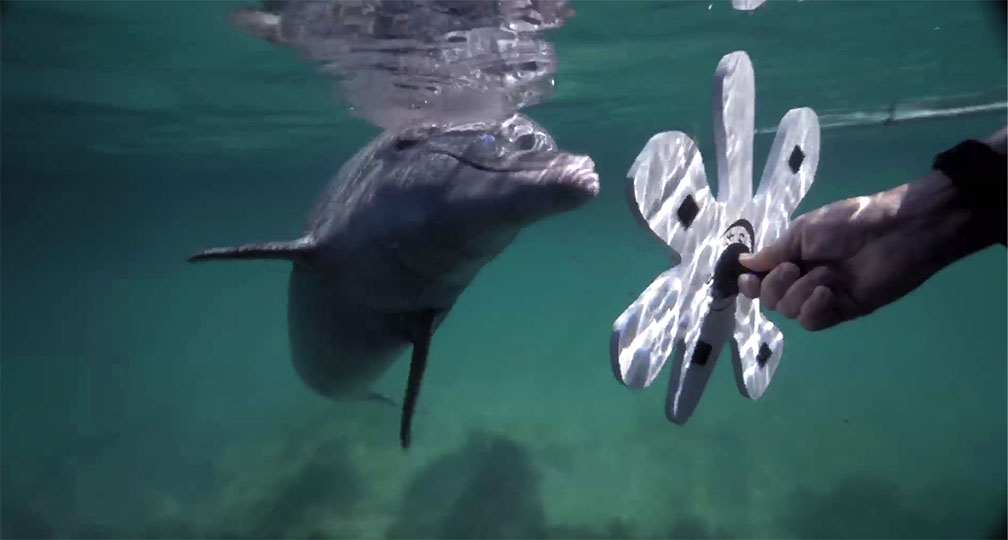
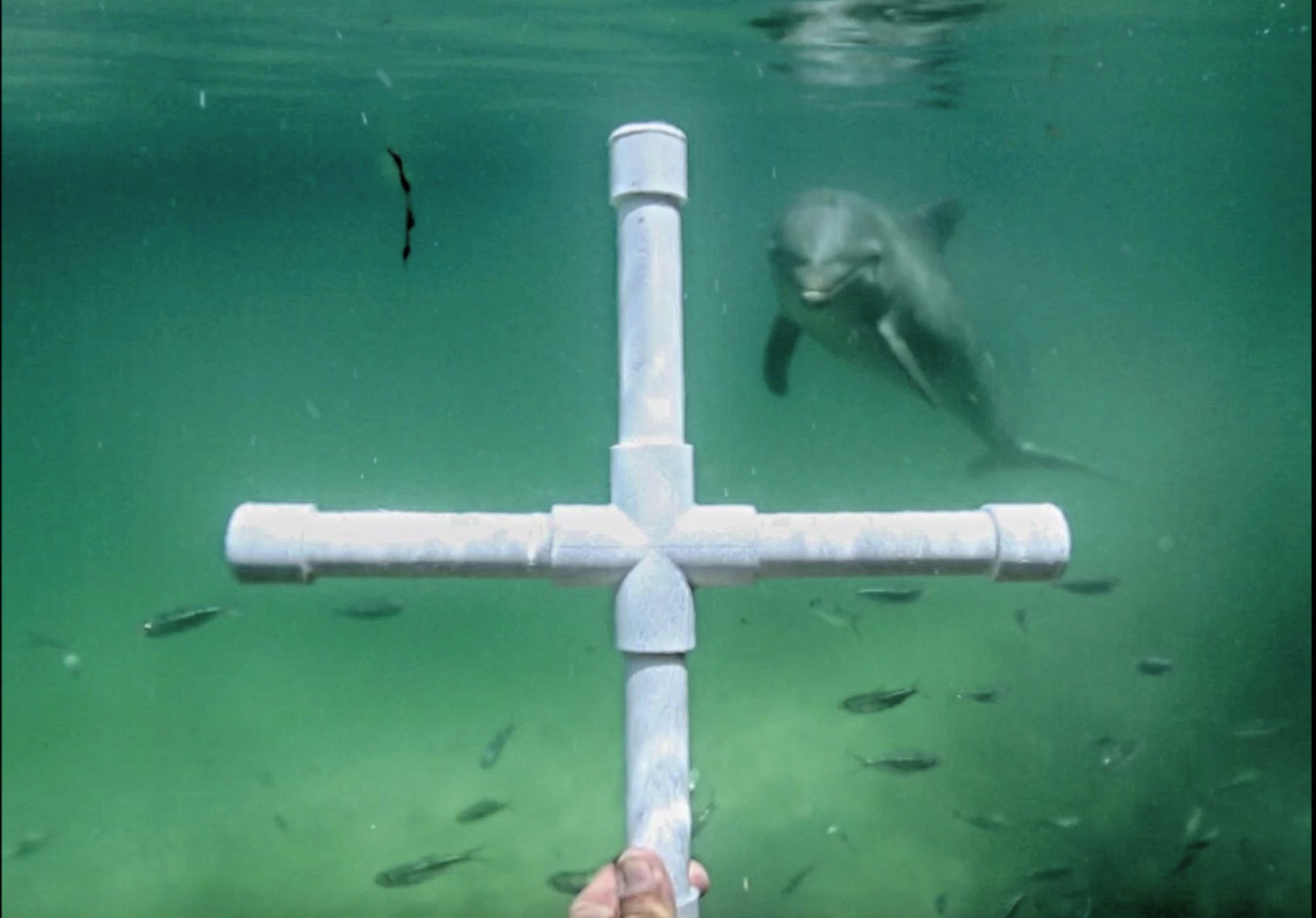
Cooperative Games
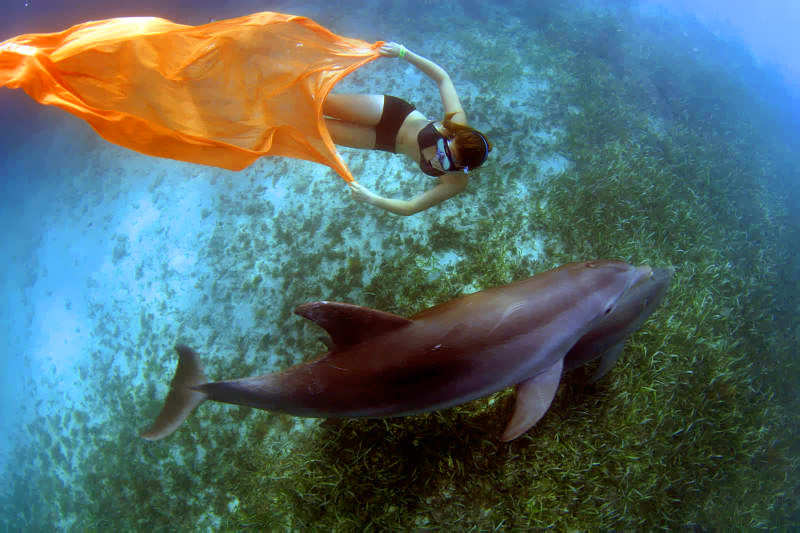
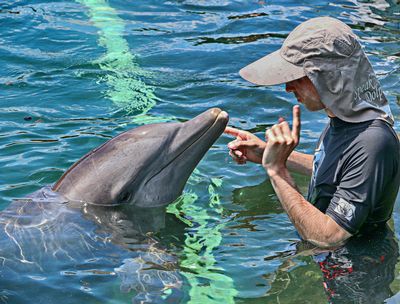
Spend a little time with dolphins, and you'll soon observe that games are important in
their social interactions. Therefore, the creative use of games is an indispensable
tool when building relationships with dolphins. Often, during the course of these games,
we experience both acoustic and non-verbal communication. We believe that cooperative
games are an important building block for humanity's evolving relationship with dolphins
and we continue to seek out new methods of play to share with the dolphins, such as our Earth
Flag Ceremony, Ribbon Games, and the Propeller Game. Read more...
Dolphin Big Bang No Longer A Theory
For years researchers have postulated that dolphins could use their echolocation to
stun prey fish. Recent scientific papers have been published refuting that possibility.
However, we have recorded Castaway, a wild, offshore bottlenose dolphin, using her echolocation
to stun and kill a mullet fish. Two eye-witnesses also can verify this event.
Read more...
Dolphin Language Analysis
Our state-of-the-art digital recording capabilities allows us to capture the complete audio
spectrum of dolphin vocalization and echolocation. Therefore we are scientifically
assessing and analyzing dolphin vocalization and echolocation in ways that were
impossible only a few years ago. Within these recordings we have discovered an
astounding pattern of melodic modes which are unique to each dolphin and are equivalent
to musical notes and chords. These dolphin "songs" are beautiful, yet, so complex that
the human ear cannot decipher them without the aid of technology. To help the human ear
make sense of these complex dolphin sounds, we have musicians play these musical patterns
or "dolphin songs", which are available on our Dolphin Code CD.
We are also in the process of creating an innovative system of written notation for transcribing
the unusual qualities inherent in the inh2idual notes produced by dolphins.
Human definitions of language require speech (the signals we use), syntax (the structure we use),
and semantics (the signals we use). Researchers must consider the possibility that dolphins
may possess a language of tones, inflections, and timing found in languages like Chinese and
the whistling language of the Silbo Gomera of the Canary Islands. We believe the discoveries
that we have made point to the possibility of a robust language that developed on a different,
but tangential, evolutionary path. It is quite possible that the human definition of
"language" will have to broaden in order to encompass the dolphins' use of language.
DATA - Dolphin Acoustic Trainer's Assistant
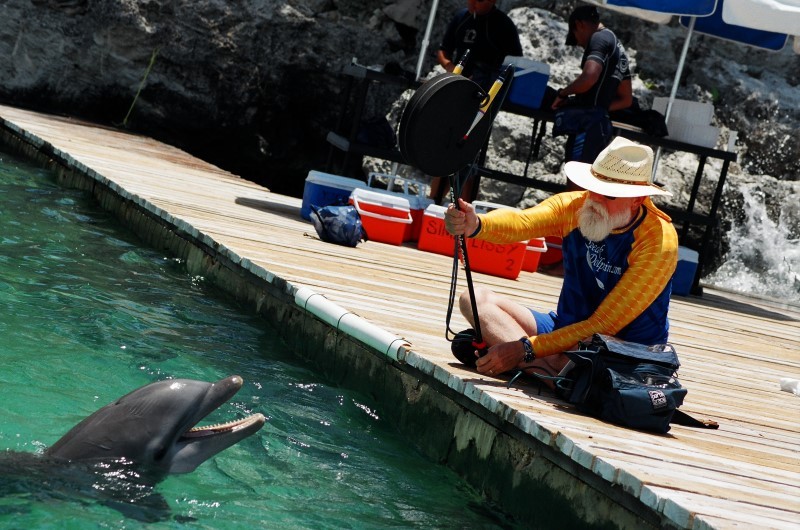
We are developing this lightweight and waterproof underwater listening system so that dolphin
trainers (and researchers) can better recognize the communication between dolphins as the
animals carry out their trained behaviors during dolphin swim programs and dolphin shows.
We believe the portability of this system will give trainers much insight into underwater
interactions (which are often overlooked or impossible for the trainer to view) between dolphins
during sessions. Such acoustic insight to each dolphin's communication, will allow the trainer
to develop a better working relationship with the animals under their care.
For example, a dolphin trainer using this system on a daily basis, would soon be able to
recognize the inh2idual dolphin voices as the dolphins discuss plans to perform a jump
that they were just given a signal or command for. This would allow the trainer to refine
their own skills for better communication with the dolphins through improved hand signals,
whistle blows for bridging, etc. Also, the trainer would be more informed about personality
conflicts between dolphins and genuine stress calls - important tools for any dolphin care giver.
This system will also work on research boats, allowing multiple on-board observers to move about
the boat freely, while still listening to wild cetacean sounds through their wireless headphones.
Please contact us regarding further development of this system.
Motor Response to an External Auditory Stimulus: Potential Predicate to Entrainment in the Bottlenose Dolphin (Tursiops truncatus)
This preliminary investigation looks at the entrainment of dolphins to a particular musical
beat. The reaction of the dolphins is being compared to entrainment in birds to the same
musical beat. Entrainment in the biomusicological sense refers to the synchronization
of organisms to an external rhythm, usually produced by other organisms with which they
interact socially. Examples include firefly flashy, mosquito wing clapping as well as
human music and dance. We are carrying out the dolphin portion of this study, in
cooperation with Dr. Marc Hauser of Harvard University.
Software Weighting and Ratings System
We are developing a much needed committee called The Scientific Software and Hardware
Rating Board (SSHRB). These ratings will provide brief and neutral information about the
content and components in computer application programs and recording/analysis hardware
that are used in bioacoustics interpretation of sound and data. SSHRB ratings would have at
least two equal parts: (1) rating symbols suggesting publishing levels of scientific confidence
based upon neutral benchmarks for both the application software and recording/analysis
hardware (2) content descriptors indicating elements and components in an application
program or recording/analysis hardware that may create a problem for researchers (i.e.
aliasing in known acoustic research and teaching tool application programs, compressing
of files that is unreported or false reported by the recording and analysis equipment). A
transparency level of disclosure would be implemented so that research results have a level
playing field across academic comparisons. The goal of these committee objectives would
be to have the industry use this rating system on their products so that researchers can
choose the appropriate software and hardware for their various projects.
A Scientific Readiness Rating Program is intended to decrease errors in evaluating application
software and recording/analysis hardware. The rating system would utilize an open-source model
with scores rated by users of these application programs and recording/analysis equipment.
This rating system would have numerous categories, including functionality, usability, quality,
security, documentation and technical support. Each category would be rated on a scale of
1 to 10. There would also be bias tools so a potential academic user can specify its most
important considerations.
Hyperboloid Coincident Acoustic Model by Jack Kassewitz and Mark Weber
The bottlenose dolphin, Tursiops truncatus, has had its dual phonation device(s) described
extensively in the literature: it offers both binaural receiving and biphonic (or bivocal)
transmitting capabilities. The following model, Photograph 2, is based upon my recording and
analyzing their sounds and a bit of a hunch what takes place when you have an outgoing multiple
source signal that has coincident wave behavior increasing amplitude arithmetically. A research
paper will be forthcoming regarding this new model for echolocation.